When it comes to handling and transporting stabilizer powders in industrial applications, selecting the right conveying method is crucial for efficiency, safety, and product integrity. As a leading provider in the field, Shandong HeadPowder Engineering Co., Ltd. understands the diverse needs of clients and offers a range of effective solutions tailored to different operational requirements. This article explores the primary types of stabilizer powder conveying methods, highlighting their characteristics, advantages, and typical applications.
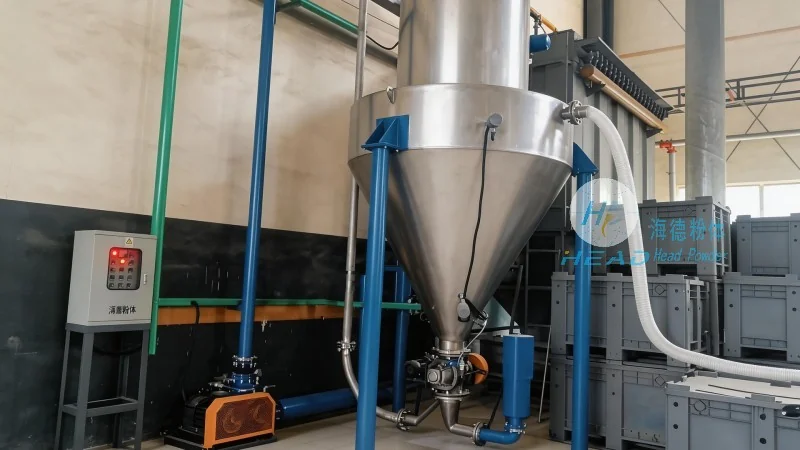
1. Pneumatic Conveying Systems
Pneumatic conveying systems utilize air or other gases to transport powder materials through a pipeline network. This method is widely used for stabilizer powders due to its ability to handle fine powders without the need for mechanical components that might cause product contamination or degradation. There are two main types of pneumatic conveying: pressure and vacuum systems.
Pressure systems operate by forcing air or gas into a sealed pipeline, pushing the powder forward. They are suitable for long-distance transport and can handle high volumes of material. However, they require robust equipment and may be less efficient for short-distance applications. Vacuum systems, on the other hand, use a vacuum to draw the powder into the pipeline, making them ideal for applications where the material needs to be moved from a lower to a higher elevation or from a source to a collection point. Both systems offer advantages in terms of minimal product degradation and the ability to integrate with other processing equipment.
2. Screw Conveyors
Screw conveyors, also known as auger conveyors, are mechanical devices that use a rotating screw to move powder materials along a trough or tube. This method is commonly employed for stabilizer powders in industries such as food processing, pharmaceuticals, and chemical manufacturing. Screw conveyors are particularly effective for materials that are free-flowing and non-abrasive, as they can handle these powders without causing excessive wear or damage.
The design of a screw conveyor typically includes a helical screw blade mounted on a shaft, which rotates within a U-shaped or tubular housing. As the screw rotates, it pushes the powder forward, allowing for both horizontal and inclined transport. One of the key advantages of screw conveyors is their simplicity and low maintenance requirements. They are also capable of handling a wide range of powder characteristics, including varying moisture content and particle sizes. However, they may not be suitable for very fine or cohesive powders, as these materials can stick to the screw or the housing, leading to blockages and reduced efficiency.
3. Vibratory Conveyors
Vibratory conveyors use vibration to move powder materials along a conveyor bed. This method is particularly effective for handling cohesive or sticky stabilizer powders that might be difficult to transport using other methods. The conveyor consists of a trough or tube that is mounted on vibration motors or eccentrics, which create a shaking motion. This motion helps to break up clumps and move the powder forward.
Vibratory conveyors are often preferred in applications where the material needs to be transported over long distances or at elevated heights. They are also suitable for materials that are sensitive to impact or abrasion, as the gentle shaking motion minimizes product damage. Another advantage of vibratory conveyors is their ability to handle a wide range of particle sizes and moisture contents without the need for additional equipment like classifiers or separators. However, they may require more maintenance than other systems due to the moving parts and the need to keep the vibration components in good working order.
4. Belt Conveyors
Belt conveyors are another common method for transporting stabilizer powders, especially in bulk handling operations. This system uses a continuous belt that moves over rollers or pulleys to transport the powder from one location to another. Belt conveyors are highly efficient for moving large volumes of material over long distances and are often used in conjunction with other equipment such as hoppers, feeders, and storage silos.
The design of a belt conveyor typically includes a wide, flat belt that is supported by a series of rollers. The belt is driven by a motor, which causes it to move at a constant speed. The powder is loaded onto the belt at one end and is carried to the discharge point at the other end. One of the key advantages of belt conveyors is their ability to handle a wide range of powder characteristics, including abrasive or heavy materials. They are also relatively low-cost to install and maintain compared to other conveying systems. However, belt conveyors may not be suitable for very fine powders, as these materials can fall through the belt or cause it to slip. Additionally, they require regular cleaning and maintenance to prevent the buildup of material on the belt surface.
5. Hydraulic Conveying
Hydraulic conveying systems use a liquid medium, typically water or a specialized fluid, to transport powder materials. This method is particularly effective for handling very fine or cohesive stabilizer powders that are difficult to move using other methods. The powder is mixed with the liquid to form a slurry, which is then pumped through a pipeline to the desired location.
Hydraulic conveying is often used in applications where the material needs to be transported over long distances or at high pressures. It is also suitable for materials that are sensitive to air exposure or moisture, as the liquid medium helps to protect the powder from oxidation or degradation. However, hydraulic systems require more complex equipment and may be more expensive to operate compared to other conveying methods. They also generate more waste liquid that needs to be treated and disposed of properly.
6. Air-Lift Conveyors
Air-lift conveyors are a specialized type of pneumatic system that uses a vertical pipeline to transport powder materials. This method is particularly effective for moving powder from a lower to a higher elevation, such as from a storage silo to a processing unit. The system consists of a vertical pipe with a hopper at the bottom and a venturi or nozzle at the top.
As air is blown through the nozzle, it creates a low-pressure zone that draws the powder up the pipe. The powder is then carried to the top of the pipe and discharged into a collection hopper. Air-lift conveyors are highly efficient for vertical transport and can handle large volumes of material with minimal energy consumption. They are also relatively simple to install and maintain compared to other vertical conveying systems. However, they may not be suitable for very fine or abrasive powders, as these materials can cause wear on the pipe and nozzle components over time.




