Gray calcium, a common industrial material, often requires efficient and reliable material handling solutions for its transportation from production sites to processing or storage areas. Pneumatic conveying, a technology that uses air or gas to transport bulk materials, has become a preferred method for handling gray calcium due to its advantages in safety, cleanliness, and flexibility. This article explores the fundamental principles of gray calcium pneumatic conveying, outlines the main classifications of such systems, and discusses their practical applications in various industrial settings, with a focus on the expertise of Shandong HeadPowder Engineering Co., Ltd.
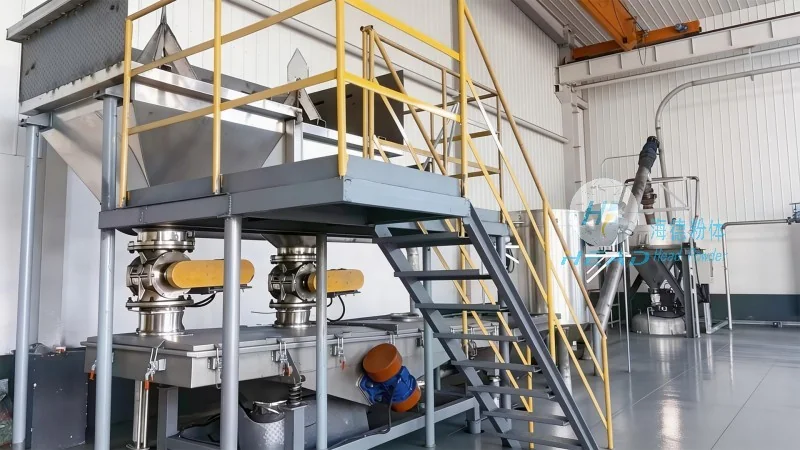
Core Principles of Pneumatic Conveying for Gray Calcium
The operation of gray calcium pneumatic conveying systems is based on the fundamental principle of transporting solid particles through a pipeline using a moving air stream. The process involves several key steps: material feeding, air induction, particle suspension, and delivery to the destination. In a typical system, gray calcium is fed into a hopper or feeder, where it is then introduced into a pipeline. Simultaneously, a fan or blower generates a high-velocity air stream that carries the calcium particles along the pipeline. The air velocity must be sufficient to overcome the gravitational force and frictional resistance of the particles, ensuring stable suspension and smooth transport. The design of the conveying system, including the air velocity, pipeline diameter, and length, is critical to achieving efficient and low-loss transport of gray calcium.
Classification of Pneumatic Conveying Systems for Gray Calcium
Pneumatic conveying systems for gray calcium can be broadly classified into two main categories: dilute-phase and dense-phase systems. Each type has distinct characteristics and is suitable for different operational requirements.
Dilute-phase pneumatic conveying systems operate at air velocities that are typically 20-30 times the terminal velocity of the particles. This high velocity ensures that the particles are fully suspended in the air stream, resulting in a low pressure drop and high conveying capacity. Dilute-phase systems are commonly used for short to medium distances and are suitable for handling fine or moderately fine gray calcium powders. They are often preferred for applications where material degradation is a concern, as the particles are less likely to experience friction or impact.
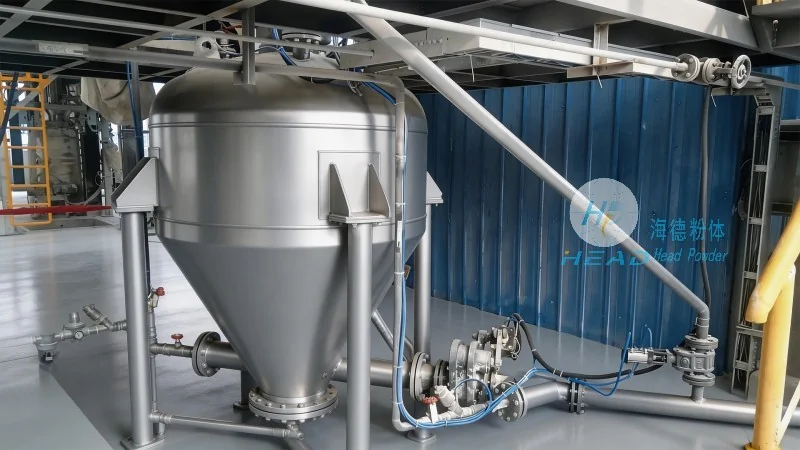
Dense-phase pneumatic conveying systems, on the other hand, operate at lower air velocities, typically 5-10 times the terminal velocity of the particles. In this mode, the particles are conveyed in a more compact state, with a higher solids concentration. This results in a higher pressure drop and lower conveying capacity compared to dilute-phase systems. Dense-phase systems are ideal for long-distance transport and for handling materials that are prone to segregation or degradation under high-velocity conditions. They are commonly used for transporting bulk gray calcium from production facilities to storage silos or processing plants over considerable distances.
Application Scenarios in Industrial Settings
The versatility of gray calcium pneumatic conveying systems makes them applicable across a wide range of industrial sectors. In the construction industry, for example, gray calcium is often used as a raw material for cement and concrete production. Pneumatic conveying systems enable the efficient transport of gray calcium from storage silos to mixing plants, ensuring a consistent supply of material for production. In the chemical industry, gray calcium may be used as a filler or additive in various products, and pneumatic conveying facilitates its transfer from storage to processing equipment.
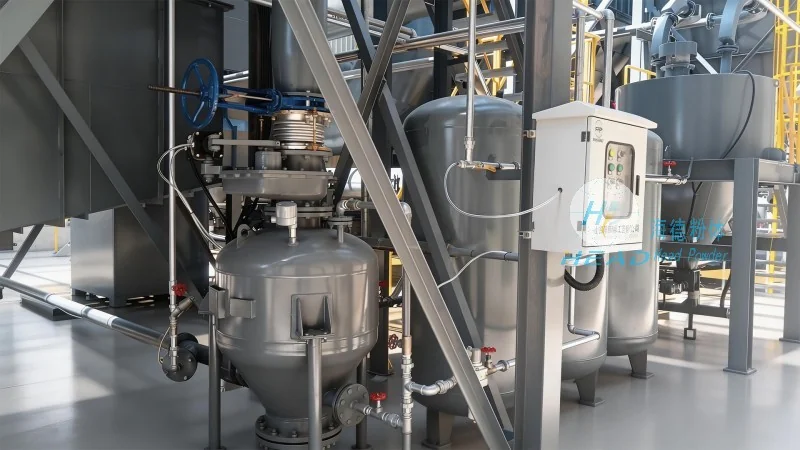
In the mining and mineral processing sector, gray calcium is sometimes extracted from ore and needs to be transported to processing facilities. Pneumatic conveying systems provide a clean and efficient method for moving the material, avoiding the need for traditional belt or bucket elevators that can be prone to material spillage and contamination. Additionally, in the food and pharmaceutical industries, where material purity is paramount, pneumatic conveying offers a hygienic solution for transporting gray calcium, as it minimizes contact with external contaminants and reduces the risk of cross-contamination.
Key Considerations for System Design and Implementation
When designing a pneumatic conveying system for gray calcium, several factors must be carefully considered to ensure optimal performance and efficiency. The first is the particle size and density of the gray calcium, as these properties directly affect the required air velocity and system pressure. Larger or denser particles may require higher air velocities or different system configurations to achieve effective transport. The second consideration is the distance and elevation change between the source and destination points. Longer distances or significant vertical lifts may necessitate the use of dense-phase systems or additional boosters to maintain sufficient air pressure and velocity. Shandong HeadPowder Engineering Co., Ltd. specializes in customizing pneumatic conveying solutions tailored to the specific needs of gray calcium handling, ensuring that systems are optimized for efficiency and durability.
Another critical factor is the system's material compatibility. The pipeline and components must be resistant to the chemical properties of gray calcium, as some calcium compounds can be corrosive or abrasive. Materials such as stainless steel or specialized coatings are often used to prevent wear and corrosion. Additionally, the system's control and monitoring capabilities are important for maintaining consistent operation and detecting any issues, such as blockages or pressure drops, that could affect performance.




